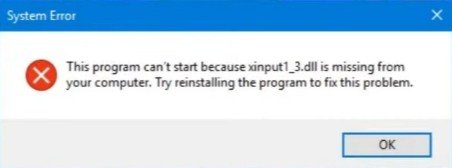
When running games, emulators, or software on an older PC running Windows, you might encounter an error message stating “XInput1_3.dll is missing.” This usually indicates that a critical file has been deleted from the system. You can resolve this issue by installing the XInput1_3.dll setup file appropriate for your version of Windows.
XInput1_3.dll is a system component file primarily associated with DirectX and XInput technology; it is used by certain applications to handle controller or gamepad inputs. If this file is missing or corrupted for any reason, the application may launch and then immediately close. Several versions of XInput1_3.dll are available, and a list of them is provided below.
Xinput1_3.dll || v3.3.1.444 || Size: 81KB
SHA1: 46097f492539bd1170f5cb224644d5ec80af5c2a
MD5: 5ef305924d602d4d5d1ad416f805af2b
Xinput1_3.dll || v9.18.944.0 || Size: 40KB
SHA1: dad190ac0e9a5f5e3396cf3445caad5edb3e02d8
MD5: 1b39ba63e8801cefbfa4c6a4b90f1e38
Xinput1_3.dll || v9.18.944.0 || Size: 44KB
SHA1: 1a97d6b77230855c19fd8a92a0a3a59645a84b75
MD5: 4214e1eab701de87c2151c30a1ada24a
Xinput1_3.dll || v10.0.26200.1 || Size: 80KB
SHA1: 33b6d3e7f466449f45ea63ce1cd8262ac210d913
MD5: a573b9cb153dabc8bd793168ae390e0e
About XInput1_3.dll
XInput1_3.dll is a Dynamic Link Library (DLL) file. It is a component associated with Microsoft and is used by applications that require game controller input. This file enables certain games and software to communicate with input devices like compatible gamepads. It is not essential for every Windows user; only those who use specific games or applications may require it.
Where is XInput1_3.dll used?
This file is found in games and applications that utilize the Microsoft XInput API or older components. It is used with:
- Xbox-compatible controllers
- USB gamepads
- Certain third-party controllers
- Older PC games
- Some emulators
- Certain gaming utilities
How does this file get deleted or corrupted?
Let’s look at the main reasons why XInput1_3.dll might get deleted. Security software on your PC may sometimes flag the file as suspicious and delete or corrupt it. If this happens, a “missing DLL error” will appear. However, simply disabling your antivirus is not the right solution. Instead, you should verify the file or software and ensure it is downloaded from a trusted source.